


To help ensure that everyone is treated fairly and consistently, our Behaviour policy runs across the whole Group (Beavers, Cubs and Scouts). To make it clear for the different age ranges, sections may have their own Code of Conduct on top of this to make it easier to understand by that age, and to cover any topics their members think particularly relevant to them.
If members break this policy then we will give a yellow or red card so that we are completely clear about the issue and so that everyone knows that a line has been crossed. Hopefully this is a one-off and there will be no follow-up required.
Ultimately we hope everyone will engage in Scouting in the spirit of the Scout Promise and the Scout Law. We would much prefer not to have to deal with misbehaviour: it is unfair on the adults and it is also unfair on those Young People who are behaving and want to get on with activities. This code will be strictly enforced. Your Young Person’s attendance will be taken as acceptance of these rules.
We operate two cards.
A Yellow card will be given for:
(Please note anyone getting three+ yellow cards in any half-term will be issued a Red card.)
- Persistent talking when they should be listening
- Messing around or wandering off during activities
- Inappropriate language, name calling, inappropriate noises, inappropriate gestures and similar
- Any actions to maliciously provoke a response from someone else (flicking, prodding, etc.)
- Failure to follow reasonable instructions from the Leaders or Senior Members (Lodge Leaders, Sixers, Patrol Leaders)
- Deliberately damaging or destroying property – light damage, e.g. damaging posters
A Red card will be given for:
- Fighting
- Any form of bullying
- Any form of discrimination
- Anything which damages the reputation of Scouting (misbehaviour with guests, in a public place, and similar)
- Deliberately damaging or destroying property – serious damage, e.g. deliberately leaving taps on, or graffiti on tables
Consequences:
This is our normal framework which we will follow where practical. In serious cases we reserve the right to jump straight to red card 2 or 3:
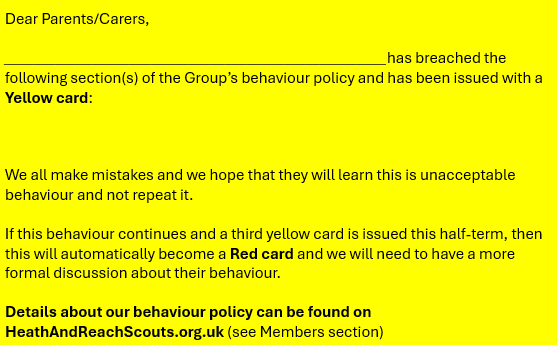
Yellow card: Parents are informed by an adult. This will be fairly informal.
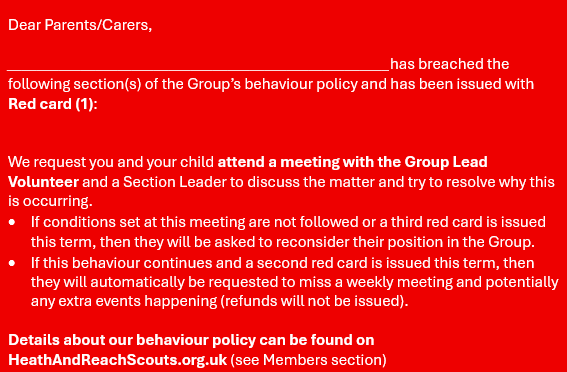
1 red card: Parents are informed either by face-to-face discussion or by email as to why. Group Lead Volunteer or a member of the Leadership team (not directly involved) may be invited to assist with conversations.
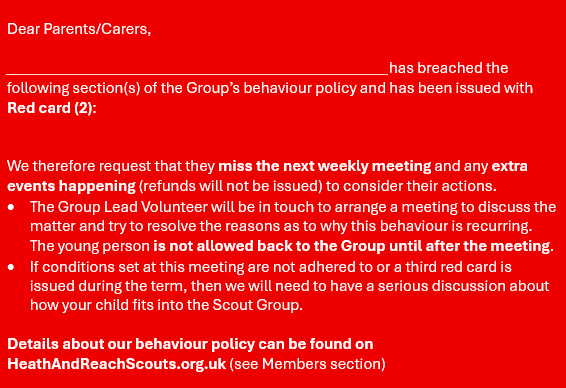
2 red cards in any term: Miss a week plus a discussion with parents and Group Lead Volunteer
3 red cards in any term: there needs to be a serious conversation about the Young Person’s position in the Group and whether it is right for them, plus guarantees put in place to stop repeat offences.
The message to be issued will be a standard format according to colour of card and will read as follows:
Revision history:
March 2026: Added discrimination, and reworded that there may be a code of conduct for different age ranges. Slight rewording. Added example cards.